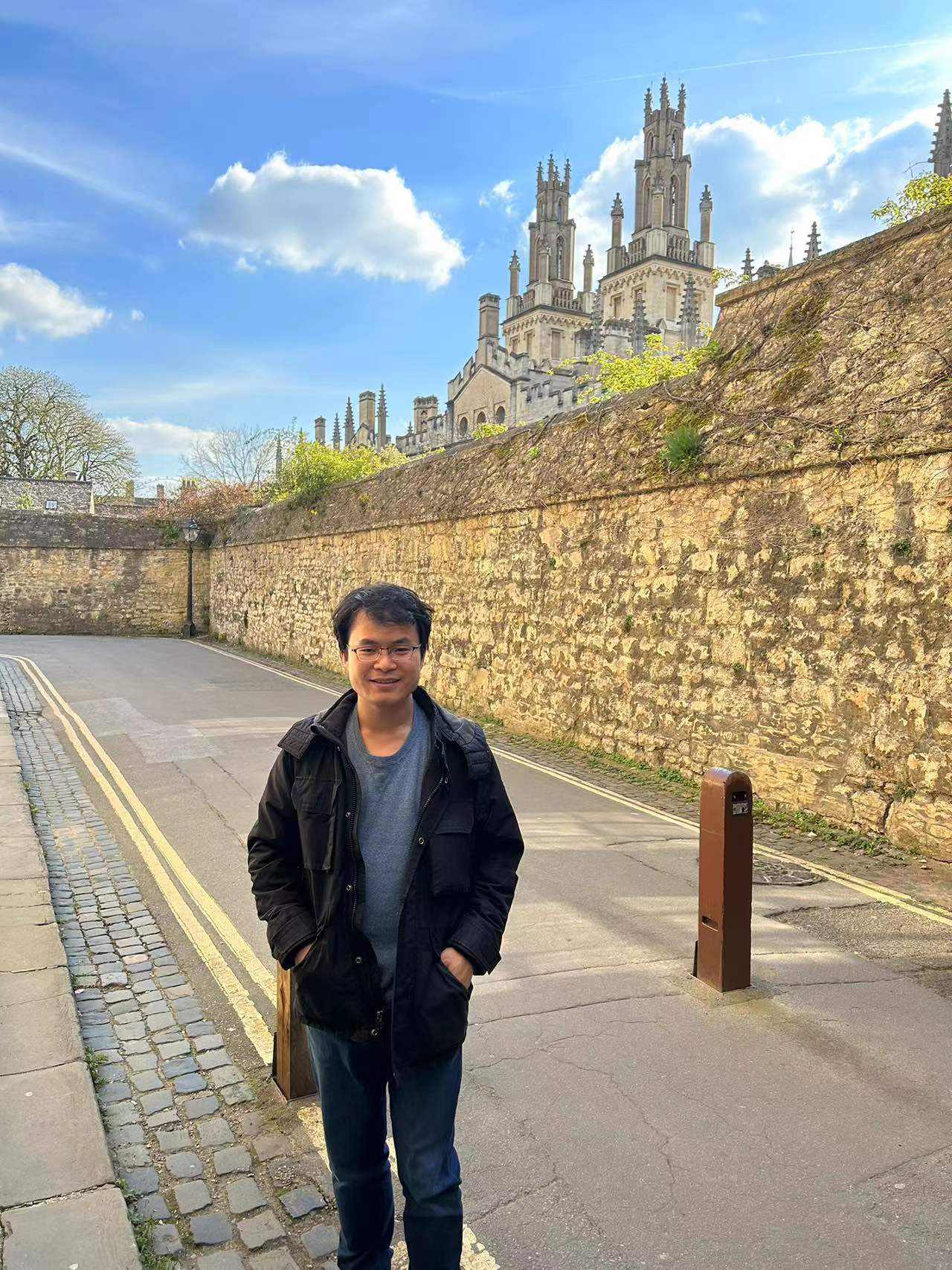
Associate Professor, Key Laboratory of Mathematics Mechanization, Chinese Academy of Sciences. (Prior to this, I was a research associate at the School of Mathematics, University of Bristol working with Ashley Montanaro and Noah Linden. I received my PhD from the University of Chinese Academy of Sciences under the supervision of Prof. Hongbo Li.)
Research interests: quantum computation, quantum algorithms, quantum complexity theory and some relevant mathematics
My research aims to better understand the power of quantum computers. I am especially interested in quantum algorithms, quantum query, communication and circuit complexity. I am also interested in symbolic computation, where I use tools from Clifford algebra, computational algebraic geometry, and invariant theory to automated reasoning. Some other interesting research topics include the Kaczmarz method and randomised numerical linear algebra.
"If you can't do great things, do small things in a great way. Don't wait for great opportunities. Seize common, everyday ones and make them great." --- Napoleon Hill
Google Scholar, arXiv, Some talks, A full list of publications, the following is a list of preprints
Transducer-based linear combination of unitaries: theory and applications
with Dong An,
Dekuan Dong,
Yuxin Zhang,
Chenhao Zhao
arXiv:2609.40073
Quantum space-depth tradeoffs for coherent block encodings
with Yuxin Zhang
arXiv:2607.01843
Worst-case Harrow-Hassidim-Lloyd algorithm with average-case correct quantum Fourier transform
arXiv:2604.10428
DQC1-completeness of normalized trace estimation for functions of log-local Hamiltonians
with Zhengfeng Ji,
Tongyang Li, Xinzhao Wang,
Yuxin Zhang
to appear in FOCS 2026
arXiv:2604.01519
In our paper, Theorem 2.10 is the key theorem underlying all our results. We
spent too much time—maybe half a year—trying to prove a general result, but
failed and only obtained a conditional result in the end, before turning to AI.
Recently, with the help of GPT-5.6 Sol, we proved more general results
(see this note and
this revised note, which were written by GPT).
The first result is a little surprising, because it only uses a uniform periodic
Jacobi matrix with $a_i=0,b_i=1/2$ of dimension depending on the input function.
In our paper, the choices of $a_i,b_i$ highly depend on the input function.
Interestingly, this Jacobi matrix is indeed the case used in all previous results
for some specific functions. This particular Jacobi matrix corresponds to
Chebyshev polynomials, and from the findings of our paper, it seems to be a
natural object in DQC1-hardness. The extra condition for DQC1-hardness is
much weaker than the one in our paper. The second result is quite impressive:
it says that DQC1-hardness holds for all Lipschitz functions. Note that
previously, the DQC1 quantum algorithm given by Cade and Montanaro was
also for Lipschitz functions (arXiv:1706.09279). The proof is quite different
from our current proof in the paper. I may have missed some points, but I
checked the proofs and did not find any serious issues.
DQC1-hardness of estimating log-determinants [Notes]
with Xinzhao Wang
In this short note, we prove that estimating the log-determinant of log-local Hamiltonians is DQC1-complete.
Randomized Quantum Singular Value Transformation
with Xinzhao Wang, Yuxin Zhang,
Soumyabrata Hazra, Tongyang Li,
Shantanav Chakraborty
arXiv:2510.06851
Quantum singular value transformation without block encodings: Near-optimal complexity with minimal ancilla
with Shantanav Chakraborty,
Soumyabrata Hazra, Tongyang Li,
Xinzhao Wang, Yuxin Zhang
arXiv:2504.02385
Low-degree approximation of QAC0 circuits
with Ashley Montanaro,
Dominic Verdon
arXiv:2411.00976 (withdrawn)
There is a bug in the paper that will take some time to fix.
Quantum speedup of leverage score sampling and its application
arXiv:2301.06107